Expat Explorers - travels with my family ideas...insight...inspiration
Get in contact
  • About
    • Meet the family
    • Photo gallery
  • Blog
  • Travel ideas & advice
    • Expat suitcase >
      • Moving to Dubai
      • Moving to Singapore
    • Jigsaw pieces: travel advice
    • Australasia
    • Middle East
    • South East Asia
    • USA
    • Where in the world are we?
  • In the news
    • Freelance work
    • Who said that? Travel quotes
    • Signs that make you think
  • The book
  • Contact us
    • Explorers' Club

Our day as Indiana Jones: discovering Borobadur, Java

28/4/2013

2 Comments

 
Picture
Day 7
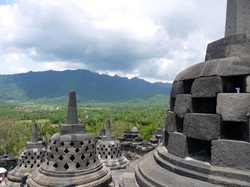
A day of culture as we headed out to the famous 9th century Buddhist temple of Borobadur. Surrounded by beautiful forests and mountains, the temple had been hidden beneath vines, bushes and volcanic ash, until being rediscovered by the Indiana Jones of the Day, Sir Thomas Stamford Raffles, our friend from Singapore, the then British Governor of Java. Intrigued by the Indonesian stories and rumours, he managed to uncover the ruins in 1814. Historians know little about why it was built or why it was abandoned.

Having had two or three rounds of renovations, it’s of course impossible to say how much of the site is original. Certainly parts have been removed or covered to adhere to current sensitivities. The monument’s six square platforms are decorated with more than 2,500 relief panels, some of which has been covered with plain blocks for being too sexually explicit. There are 504 statues of Buddha, 72 of which are seated inside perforated stupa, or mounds, resembling large bells.

To pay the due respect afforded by a temple of this status, we approached it from the east side and circumnavigated the structure three times clockwise, being rewarded with a different view at each level. Once a place of contemplation, it is on the outside of the temple that worshippers gathered – this is not a building in the traditional sense and there is no inside cavern or vestibule to visit.

With the sun beaming down, creating a steamy haze, we were forced to beat a retreat back to the air conditioning of our car by 11 o’clock. It’s worth visiting the temple early in the day, and dawn tours are popular – a little too much for us to manage with the children this time.

On the way back we planned our afternoon’s activities, but there is nothing as unpredictable as weather apparently. “Will it rain today?” is the question I asked our driver. “No. It’s the end of the rainy season.” Five minutes later the heavens opened, the roads turned into rivers and the mopeds were forced to find cover. Those who were hardy enough to venture out, gamely tried to negotiate water a foot deep in places, covering themselves only in a plastic bag.

But an hour after the rain stopped and the pavements were dry again, although the air was still thick with humidity. With an eight hour solid drive on tomorrow’s agenda, let’s hope our car is air conditioned.

Other things to try: stop at Borobadur Silver to see workshops and famous filigree jewellery.
Wander the markets and stop at Mirotar.
2 Comments

Let the train take the strain – chugging through Java

28/4/2013

1 Comment

 
Picture
Day 6
I’m looking at my watch, while running down the road, backpack flying behind me. As I rush to meet the train it pulls into the station. With a sigh of relief I take my seat just at the same time as the train pulls away, loose my balance and fall over. But this isn’t the UK, USA or any other Western country, so this doesn’t happen.

Instead we arrive at the train station an hour before the departure time. We mill around until the train arrives 40 minutes before it’s due to leave. Porters carry packages and suitcases on their shoulders and heave them on the carriages. Then we settle ourselves and sit and wait. The train leaves five minutes early. By our Western standards we should have missed it.

It all sounds very organised and civilized, but this is an antiquated system and everything needs time to get going. After all it’s apparently going to take us eight hours to travel from Bandung to Yogyakarta. Like many things in Indonesia, the trains have seen better days, although they have progressed from steam. Attempts to keep the carriages clean are dubious and questionable – the man who has just mopped the toilet floors has now swabbed the passageway with the same mop – twice.

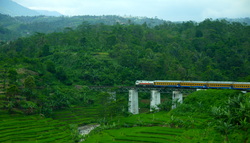
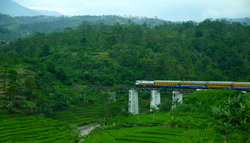
But the view from our window is inspiring. From the train window we are able to experience glimpses of life, not visible from a car, sprawled along the railway siding; lines of washing, muddy backyards, football pitches and little kiosks selling snacks. But it is the verdant countryside that is the real picture; tiered paddy fields, tumbling rivers, canyons spiked with willowy palms and banana trees, onion-domed mosques peeking above village roofs, cloud-topped mountains, ploughs pulled by ox. Life here is both simple and hard. It’s a long journey, but an interested and educational one. Taking an eight hour train journey with two small children sounded like a foolhardy idea – but it has been remarkably easy and pain free. Good practice for the ten hour car journey to come in two days time.

Accommodation: The Phoenix Hotel, Yogyakarta, central location by the Tugu Monument. Grand, elegant, fully of colonial history and great value. www.thephoenixyogya.com

1 Comment

Marry your dog? Understanding Javanese folklore

23/4/2013

0 Comments

 
Picture
Folklore is an inherent part of the Indonesian culture. It helps to explain a common thread that binds different religions, people from different ethnic origins, and backgrounds. It helps give reason to the breathtaking landscapes. It helps to give understanding to the question “why?”.

The legend of Sangkuriang may have dubious themes running through it when viewed with Western values, but it gives Indonesians a sense of belonging to the land. So let me tell you a little tale:

A princess called Dayang Sumbi refused all offers of marriage and by her own choice lived in isolation on a remote, inaccessible hill with only her dog, Tumang, for company. One day, while she was weaving, a reel fell out of the window, and Dayang Sumbi vowed to marry the person who returned it to her. Her dog ran out of the room, and returned with the reel. Good to her word Dayang Sambi married Tumang, and they bore a son called Sangkuriang.

One day, Dayang Sumbi asked her son to go out hunting and bring her the heart of a deer. Tumang went with him. Since there was no game, Sangkuriang, not wanting to disappoint his mother, killed Tumang and brought his heart back. Dayang Sumbi threw her son out and told him never to return.

After years of travelling, Sangkuriang became a bitter man, but he met a woman and fell in love, not recognising her as his mother. She did not recognise him either until many years later, when she found a scar on his head and realised it was her son. Sangkuriang asked Danyang Sumbi to marry him. She did not want to disappoint him, so set a challenge to try to discourage him. She told him she would marry him if he could create a lake by damming up the Citarum River and build her a boat in one night.

From a big tree Sangkuriang built a boat. The remains of the tree became Bukit Tanggul (Hill of the Log). The branches of the tree were stacked and became Burangrang Mountain. With the help of demons the lake was built.

With her son’s success presenting a real danger, Dayang Sumbi prayed to Sang Hyang Tunggal, the God of all Gods, to bring an early break of dawn.

When Sangkuriang found out he had been tricked he broke the dam in anger. He threw the log he used to stop the Citaram River to the east, which turned into Gunung Manglayang. The water of the lake receded. He kicked the boat to the north, which became Tangkuban Parahu Mountain. His mother fled, and is believed to have been turned into a flower.   


0 Comments

Supper time in Java: boiling an egg in a volcano

21/4/2013

0 Comments

 
Picture
Day 5:
With a population of 240 million, living on 17,000 or more islands, Indonesia is the fourth most populated places on the planet, so it is little wonder that the roads are choked with cars, and most people have opted for mopeds as their chosen form of transport. It is also little wonder that people are also choking, with exhaust fumes. It’s a chaotic scene; scooters and bikes everywhere, laden with packets. Although motorcyclists wear helmets it appears that their passengers, often children perched between their legs, don’t.

Crossing the road is a skill to master. When we visited Vietnam a couple of years ago we stood nervously for a full five minutes before an old lady grabbed us by the wrist and dragged us into the continuous stream of traffic. Thinking we were being party to her suicide mission we were a little surprised to make it to the other side. The trick is to walk slowly. There is never a gap in the continuous flow of cars, bikes, motorcycles and rickshaws, so there is little point in waiting for one. If you decide to make a dash for it, you’ll probably end up as road kill, and simultaneously bring the city to a standstill. So a leap of faith is needed. Simply step off the kerb and pretend you are a boulder in a stream that the water is forced around. The traffic adjusts to you. Move too quickly and you’ll panic everyone into a pile up. The same is true here. There may be a zebra crossing, but it is only road decoration, and serves no practical purpose. Just remember to write your will first.

To get around there is little option but to go by road. Most of the interesting sights are difficult to get to, and even if you manage to find a taxi for your outwards trip, it is unlikely to be easy to find one for the return journey. The best option is to hire a car with a driver. Driving yourself requires an entirely new skillset.

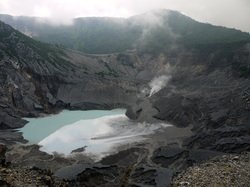
Our first port of call was Tangkuban Parahu Natural Park, famous for its active volcanoes, 1,300m above sea level. Ten days ago the poisonous gases emitted by these craters forced the park to close. Today we were lucky. The road goes right to the edge of Kawah Ratu. 500m below you can see the steam escaping from a crack in the lava rock next to a sulphurous cloudy pool. Once you’ve hired a guide, you can walk through the forest to Kawah Domas, where you can stand next to the boiling water, and even boil and egg in three minutes. A little further down the crater, the water pools are cool enough to wash in, and people use the grey clay and ground up sulphur crystals to ease skin complaints.

Ciater, a short drive away, has a number of hotels and spas where you can bath in the hot springs, but while it’s always a pleasant surprise to walk into a swimming pool the same temperature as a bath, it’s far from a healthy rejuvenating experience. The hotels are a little run down and the water is full of bugs and debris. It’s definitely an experience worth having as long as you don’t have a spotlessly clean five star spa, garlanded with frangipani, in mind.

Our final stop was Saung Angklung Udjo, set up in 1966 as a “laboratory for art education” based on the Angklung, a traditional Indonesian bamboo instrument. This tourist show keeps the music and dance alive, and is a great introduction to customs and rituals. The Angklung is a one-note instrument, and when put together, with more than 30 players, an impressive orchestra of skill is formed. If you’re only playing one Angklung, you have to know the music well enough to know when to play your note. If you’re playing a couple of octaves, you have to be quick fingered and nimble. Participation is part of the show, and our girls thoroughly enjoyed playing with the local children, dressed in their colourful finery.

0 Comments

Discovering Java: an introduction to a promise

21/4/2013

0 Comments

 
Picture
Day 4
Today has been about the journey, not just the destination. It’s been an introduction to a promise: a promise of tall tales that delight this superstitious nation; a promise of cultural enlightenment in a country whose population has been squashed and molded together like modeling clay to create a unique sculpture of ethnicity; a promise of breathtaking scenery with trains rolling over iron girder bridges spanning paddy fields tended by farmers in rolled up trousers.

Like most travellers we didn’t stay long in Jakarta. In fact we flowed straight through it, as fast as the blocked arteries of the country’s heart would take us. This gave us plenty of time to see the sprawling conurbations and the pure density that creates the capital. Fine colonial villas still stand proudly on hillsides, elevated above the throng of shanties below. While your status can not protect you from the noise and bustle of this society, money can apparently buy some privileges, which were in evidence as we saw a police motorbike slice through the thronging traffic to lead the way for a well-off businessmen.

The countryside was a breath of fresh air, or would have been if it hadn’t have been so humid. Undulating, with volcanic mountains bordering the horizon, the greenery was stunning. Hamlets, with red tile pitch roofs, nestled beneath bananas trees and in-between paddy fields. Unassuming mosques peeked above the skyline. And every now and then a golf course or a colonial mansion could be seen as the trees parted.

Bandung hits your senses in the same way as Jakarta, with more than seven million people living in the area. It’s rather down trodden and its former glory as a contender as the nation’s capital, as supported by the Dutch before the Second World War, is crumbling. Street life is always interesting though, and just ambling around you see rickshaw drivers having a chat while waiting for their next fare; teems of scooters racing from junctions; a mother and baby sleeping on the pavement; and hawkers cooking Nasi Goreng from mobile kitchens on bikes. A Western family stands out here, but people are friendly, offering a smile or a welcoming word. Tilda, with her blond ringlets, has found the attention invading her personal space and people want to touch her golden mane, but it’s all meant to be a compliment.

Bandung is a great springboard to see the surrounding volcanoes; so another adventure awaits us tomorrow.

Accommodation: Art Deco style Savoy Homann Bidakara Hotel established in 1871. Interesting colonial décor, with original features. Best of a slim selection of decent hotels; clean but still a little tired.


0 Comments
Forward>>

    Get the book

    Picture

    Destinations

    All
    Abu Dhabi
    Advice & Top Tips
    Al Ain
    America
    Argentina
    Arizona
    Australia
    Bali
    Batam
    Belfast
    Burma
    California
    Cambodia
    Chicago
    Dubai
    England
    Expat Life
    Hong Kong
    Illinois
    Indonesia
    Japan
    Java
    Jordan
    Kuwait
    Las Vegas
    London
    Malaysia
    Misc
    Myanmar
    Nevada
    New Zealand
    Northern Ireland
    Oman
    Ras Al Khaimah
    Restaurants
    Salt Lake City
    San Diego
    Scotland
    Singapore
    Southeast Asia
    Travel Musings
    Uae
    UK
    Usa
    Utah
    Wales
    Woodstock

    RSS Feed

    Or if you prefer to receive an email update click here to register.

    Archives

    June 2020
    March 2020
    February 2020
    June 2019
    April 2019
    July 2018
    June 2017
    May 2017
    December 2016
    November 2016
    July 2016
    June 2016
    April 2016
    March 2016
    January 2016
    September 2015
    August 2015
    May 2015
    April 2015
    February 2015
    January 2015
    December 2014
    November 2014
    October 2014
    September 2014
    August 2014
    July 2014
    June 2014
    May 2014
    April 2014
    March 2014
    February 2014
    January 2014
    December 2013
    November 2013
    October 2013
    September 2013
    August 2013
    July 2013
    June 2013
    May 2013
    April 2013
    March 2013
    February 2013
    January 2013
    December 2012
    November 2012
    October 2012
    August 2012
    April 2012
    February 2012
    November 2011
    October 2011
    September 2011
    August 2011
    August 2010
    June 2010
    May 2010
    April 2010
    March 2010

Powered by Create your own unique website with customizable templates.